Why Some Rugs Bleed: The Truth About Dyes, From Aniline to Vegetable to Chrome

Why Some Rugs Bleed: The Truth About Dyes, From Aniline to Vegetable to Chrome
It's one of the most stressful phone calls we get.
"I had my rug cleaned and the red bled into the cream. What happened?"
Or worse — "I spilled water on it and now there's a pink halo around the border."
Dye bleeding is one of the most common and heartbreaking things that can happen to a rug. And in our two-plus decades of cleaning rugs here in Boulder, we've seen it more times than we can count. The good news is that once you understand why it happens, you can take the right steps to prevent it — and you'll know exactly why bringing your rug to a professional isn't optional, it's essential.
Let's start at the beginning.
Three Types of Dye — and Why It Matters
Every rug is colored through one of three broad dye traditions. Understanding the difference between them is the first step to understanding why some rugs bleed and others don't.
Vegetable Dyes (Natural Dyes)
These are the oldest dye tradition in the world — plants, roots, insects, and minerals transformed into color through centuries of refined technique. Reds came from madder root, blues from indigo, yellows from saffron or weld, greens from overdyeing indigo with weld. Even insect-derived dyes like cochineal — made from dried beetle shells — produced vibrant, lasting reds. Nazmiyal Antique Rugs
The key to stable natural dyes is the mordant — a metallic salt that binds the color to the wool fiber. After soaking, dyes had to be fixed with a mordant made from metallic salts that bind colors to the fibers, stabilizing them so they won't bleed or run when the rug is washed or exposed to sunlight. When this process was done correctly and given the time it required — sometimes weeks — the result was extraordinary: colors that aged gracefully, deepened over time, and held fast through decades of use. Nazmiyal Antique Rugs
But here's the thing most people don't know: in many village-made rugs, the dyeing process was done by hand without the use of chemical mordants to lock in color — the result is stunning hues that can shift or bleed when exposed to moisture or heat. A rug can be vegetable-dyed and still be a bleeder. The dye tradition alone doesn't guarantee stability. The mordanting process does. Oriental Rug Salon
Aniline Dyes
Synthetic dyes began to replace natural dyes in the mid-1850s when they were accidentally discovered by William Perkin, an 18-year-old English chemistry student in 1856. The first synthetic dyes were produced from coal tar and were called aniline dyes. ABC Oriental Rug
They seemed like a revolution. Vivid colors, fast production, low cost. But they had a fatal flaw. These early aniline dyes had a tendency to run when wet and fade dramatically upon exposure to light, and had a devastating effect upon late nineteenth and early twentieth century rug production across the Middle East. Aniline reds in particular are notorious — beautiful on the loom, catastrophic when wet. Nazmiyal Antique Rugs
If you've ever seen a vintage rug where the red has bled into everything around it, leaving a muddy pink wash across the cream field — that's often aniline dye doing what aniline dye does.
Chrome Dyes (Chromium Mordant Dyes)
Chrome dyes, developed after 1920, do not fade or run — but they seldom have the depth and warmth of natural vegetable or insect dyes. Chrome dyes became the dominant dye technology through most of the 20th century precisely because they solved the bleeding problem. They're stable, colorfast, and consistent. Most commercially produced rugs from the mid-20th century onward use some form of chrome dye. Nazmiyal Antique Rugs
The tradeoff is aesthetic. Chrome-dyed rugs are reliable but they can look flat — that luminous, almost glowing quality you see in a well-made vegetable-dyed rug is hard to replicate synthetically. Synthetic dyes penetrate fibers evenly and with consistent depth — but when a rug is folded to see the base of the knot, a synthetic dye will show a distinct color change near the tips, while a natural dye will be uniform from tip to base. ABC Oriental Rug
The Rugs We See Bleed Most Often
After more than 20 years of cleaning rugs in Boulder, we can tell you from direct experience: the most common bleeders walking through our door are Afghan rugs from roughly the 1980s through the early 2000s — that 20 to 30 year window.
Here's why.
Afghanistan's rug industry went through enormous upheaval during this period. The Soviet invasion, the refugee crisis, the displacement of traditional weaving communities — all of it disrupted the dye traditions that had been passed down through generations. Weavers working in refugee camps or rapidly-scaled production settings didn't always have access to quality mordants, consistent dye processes, or the time to fix colors properly. The result was a generation of rugs — often beautiful in design, often well-woven — with dye jobs that were done under pressure and without the quality control of the traditional workshop system.
The reds are the biggest culprits. Afghan rugs from this era frequently used synthetic reds that were inadequately mordanted or fixed, and when those rugs get wet — even from a spill, even from a humid summer — the red moves. It bleeds into the cream, the ivory, the white. It doesn't ask permission and it doesn't stop easily.
This isn't a reason to avoid these rugs. Many of them are genuinely beautiful and historically significant objects. It's a reason to be careful — and to bring them to someone who knows what they're dealing with.
Dye type is only part of the story. Here are the other culprits we see regularly.
Alkaline cleaning solutions. Most rug dyes are acid-fast — an acidic environment helps stabilize the dye and reinforce the bond between the dyestuff and the wool. Run color is usually caused by wash water being basic in pH. The alkalinity makes susceptible colors bleed. This is why we never use the same cleaning chemistry on a rug that a carpet cleaner uses on wall-to-wall. It's a completely different animal. Jacobsenrugs
In-home cleaning residue buildup. The biggest problem with having a rug cleaned at home using wall-to-wall carpet cleaning equipment is the amount of residue left behind in the fibers. This chemical residue tends to be alkaline, and over time can affect the dyes of wool rugs and create a bleeder out of them. A rug might clean up fine one or two times at home, and on the third, the dyes bleed everywhere — because of the extended buildup of residue never properly removed. We've seen this exact scenario play out many times. Rug Chick
High heat. Carpet cleaning companies are notorious for using high heat from truck-mounted equipment to steam clean area rugs, combined with alkaline cleaning solutions — the same ones they use on wall-to-wall carpeting. High alkaline mixed with steam is a disaster waiting to happen for rugs with vegetable dyes, over-dyes, or excessive inks. Oriental Rug Salon
Pet urine. Pet urine starts as an acidic stain, then turns alkaline over weeks and months. If not cleaned up immediately off a rug, this creates long-term permanent dye damage. A rug may have colorfast dyes, but all areas with urine exposure will bleed no matter what steps are taken. This is why pet accidents need to be addressed immediately — not in a few days when it's convenient. Rug Chick
Over-dyed and artificially aged rugs. If additional color has been added after the rug was woven — to make it brighter, or to give it an antique appearance — this additional dye or ink can bleed during cleaning. With over-dye applications, especially inks, dye stabilizers don't work. You need to identify these rugs before cleaning to avert a disaster. Rug Chick
What We Do Before Every Wash
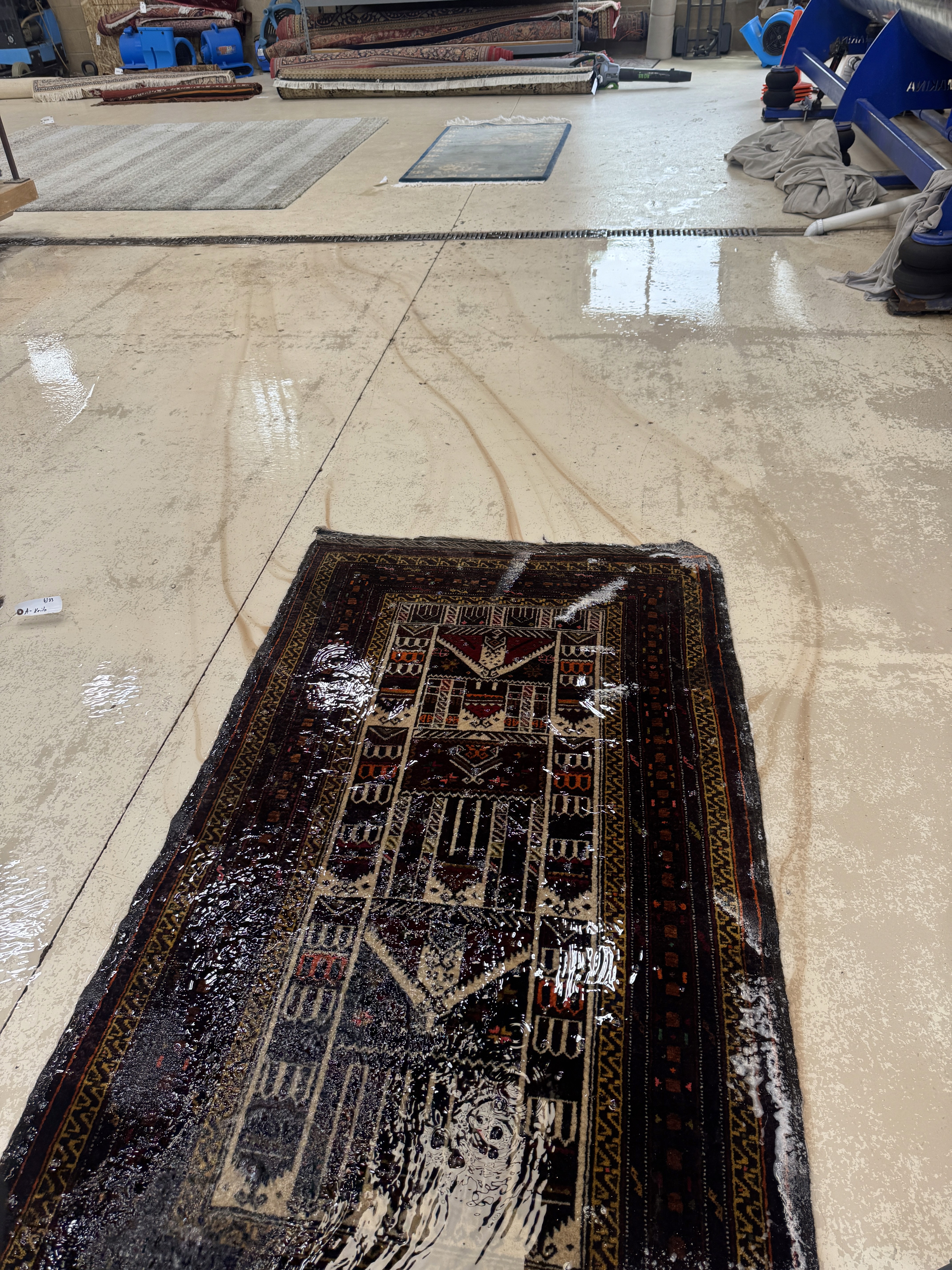
This is why every rug that comes through our door gets tested before it gets wet. We identify every primary color and check it for stability. If something is going to bleed, we need to know that before the wash — not during or after.
For rugs with unstable dyes, we use controlled rinsing processes, pH-appropriate chemistry, and careful drying to minimize migration. We've rescued rugs that other cleaners damaged and we've declined to clean rugs that no one should touch with water. Knowing the difference is the job.
If you have a rug — especially an Afghan piece from the last few decades — and you're not sure whether it's a bleeder, bring it in. We'll tell you honestly what you're dealing with and what the right approach is.
Expert Rug Cleaning — Boulder's home for serious rug care, honest answers, and 20+ years of knowing which rugs need extra respect.