>
>
Tribal Rugs: Where They Come From, What They Mean, and Why Colorado Can't Get Enough of Them
Tribal Rugs: Where They Come From, What They Mean, and Why Colorado Can't Get Enough of Them
Walk into almost any home along the Front Range and you'll spot one — a bold geometric rug with deep reds, earthy blues, warm creams, and that unmistakable raw, handmade energy. Tribal rugs have found a natural home in Colorado, and it's no accident. But before we get to that, let's go back to the beginning.

What Is a Tribal Rug, and Why Are They Called That?
The term "tribal" refers to rugs made by nomadic and semi-nomadic peoples — tribes — who wove them not for royal courts or export markets, but for everyday life. Originally, tribal rugs came exclusively from nomadic tribes, and it is these nomads who are theorized to have first mastered the knotted pile technique, which later spread over centuries across the weaving world. Nomad Rugs
These weren't decorative objects in the modern sense. They were functional — floor coverings, sleeping surfaces, saddlebags, wall insulation against the cold. The designs weren't drawn by court artists or dictated by merchants. They came directly from the weaver's memory, passed from mother to daughter across generations, encoded with meaning that went far beyond pattern.
The Persian nomadic experience centered around a twice-annual migration between mountain and lowland pastures, and five major tribes — the Qashqai, Afshar, Lurs, Kurdish, and Bakhtiari — produced a remarkable spectrum of tribal rugs. Meanwhile, in the Caucasus, weavers across Armenia, Georgia, Azerbaijan, and Dagestan developed their own distinct tribal traditions, producing rugs celebrated for bold geometric patterns and brilliant primary colors. ClaremontrugJewel Rugs
The word "tribal" stuck because it captures something essential about these pieces: they carry the identity of the people who made them.
The Language of Symbols
Every motif in a tribal rug means something. The weavers who made these pieces were telling stories, offering protection, expressing hope, and recording history — all through geometry and color.
The boteh, or paisley, is an ornamental tear-shaped motif symbolizing the universe and everlasting life — sometimes called "the seed of life," it also represents fertility. You've seen this shape your whole life without knowing its name. It's ancient. Artisera
The gul motif, found widely in Turkmen rugs, is a medallion-like design used repeatedly across the field. Traditionally, each tribe had its own distinct gul, serving as a crest and signifying the weaver's identity or lineage. Reading the guls on a Turkmen rug is essentially reading a tribal signature. Museeltd
The medallion, that central anchor found in so many tribal and Persian rugs, often symbolizes a gateway to paradise. The Tree of Life represents eternal life and is common across many cultures, signifying the connection between heaven, earth, and the underworld. The Rug Furnish
The eight-pointed geometric star was woven as a symbol of happiness, and on a spiritual level represents the ability of human beings to attain a higher level of understanding and wisdom. The ram horn motif represents masculinity, power, fertility, and heroism. Artisera
Protective motifs held a particularly important place in tribal rugs — woven especially into kilims to protect marriages, spouses, family members, children, and homes against the evil eye, ill will, and natural catastrophe. Arastan
When you walk on a tribal rug, you are walking on centuries of encoded meaning. That's not marketing language — that's just what these objects are.
The Rugs We See Most — and Clean Most
Here at Expert Rug Cleaning in Boulder, we handle tribal rugs from across the entire spectrum. Here's a guide to the types you're most likely to encounter.
Kazak Kazak tribal rugs were woven by both nomadic and village-dwelling tribespeople in the highest regions of the Caucasus. They are loosely knotted, often with thick, woolly pile, and are characterized by deeply saturated palettes of primary colors. Their elemental, often spacious designs take on a bold, graphic quality. Kazaks are tough, expressive, and age beautifully — one of the most beloved tribal styles in the world. Claremontrug
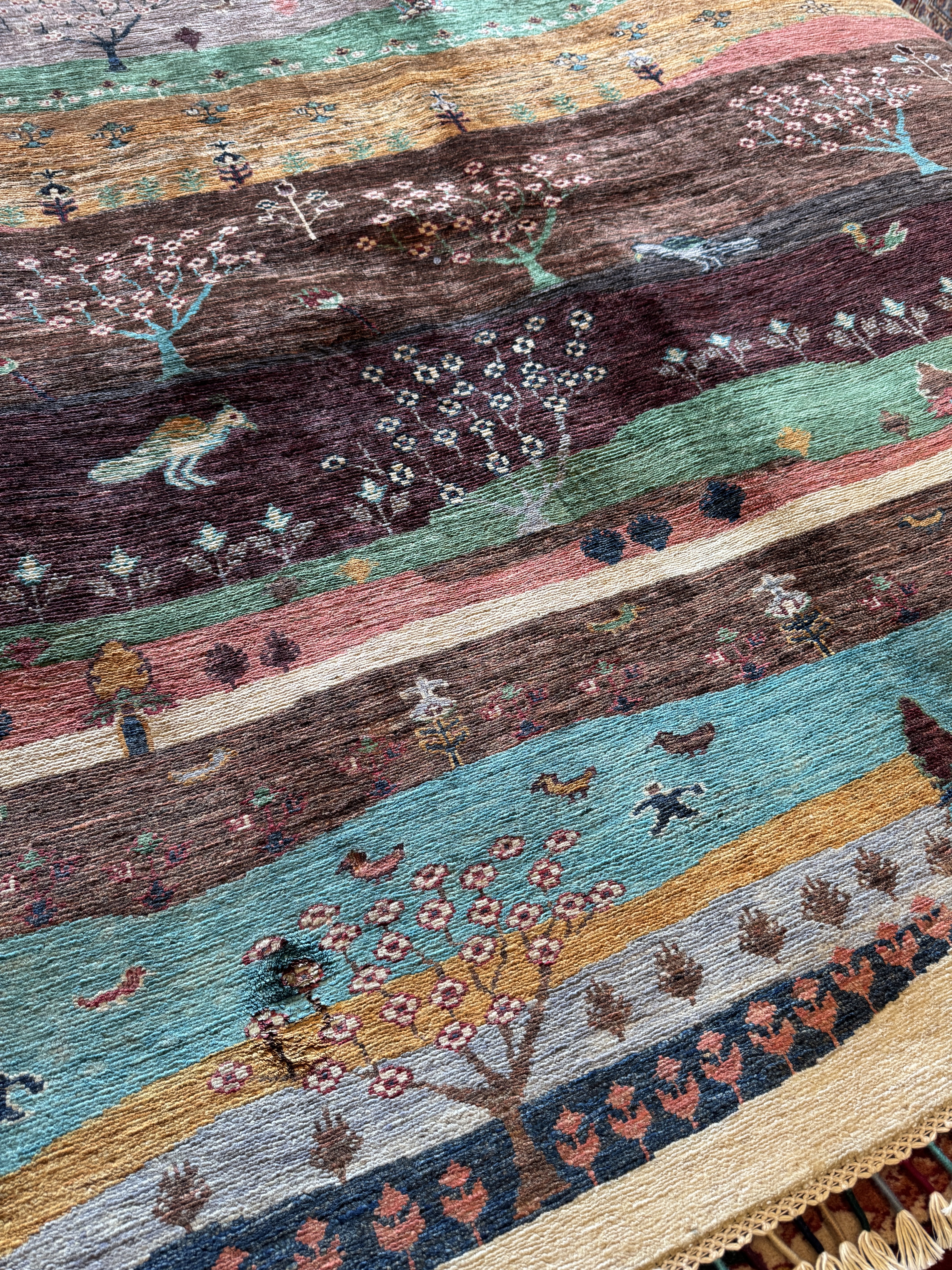
Gabbeh The word "Gabbeh" means unfinished or unclipped, and originally referred to simple, whimsical rugs that Persian weavers kept for themselves — sometimes used for sleeping, with long pile and a quick, freeform weave. Modern Gabbehs are known for their bold, almost naive compositions and deeply saturated vegetable-dyed colors. They're joyful rugs, unpretentious and full of life. Paradiseorientalrugs
Shirvan Shirvan rugs come from the Caucasus region and are known for more intricate designs with finer weaving than their Kazak neighbors. Where Kazaks are bold and muscular, Shirvans are detailed and precise — intricate repeating patterns, elegant borders, and a refined geometric vocabulary. Jewel Rugs
Mamluk Mamluk rugs have a rich history that originated in Egypt during the Mamluk Sultanate (1250–1517 CE), produced under the royal court's supervision and renowned for intricate geometric patterns and exceptional craftsmanship. There are only around 100 original Mamluk rugs left in the world — the rest are in museums. Today, Afghan rug makers have revived Mamluk designs, blending historical patterns with natural dyes from Afghanistan's terrain to create something that honors the ancient while feeling entirely alive today. The result is one of the most visually dramatic rugs on the market — deep reds, emerald greens, sapphire blues, all organized around kaleidoscopic central medallions. Rugnify + 2
Khal Mohammadi Khal Mohammadi rugs copy designs pioneered by the famous Turkmen Ersa-ri dealer Khal Mohammad, whose key to success was an extremely innovative use of natural dyes — in particular, his natural reds are considered exquisite. These are refined, richly colored Afghan rugs with a deep warmth that's hard to describe until you see one in person. Wordpress
Horjin (Khorjin) Khorjin are traditional double saddlebags historically used by nomadic tribes to carry goods on horseback. Today, Afghan artisans produce decorative flat Khorjin panels and complete double-bag sets prized for their intricate small-scale patterns and vivid color combinations — working exceptionally well as unique wall hangings or accent pieces. They're among the most collectible tribal weavings available, small in scale but enormous in character. Aseel
Beluch (Baluch) The Beluch — or Baluch — is the rug we see most often in our cleaning shop, and that tells you something about how widely loved they are. Baluch rugs are woven by the Qashqai nomadic tribes and related groups near the Afghan-Iranian border, with bold, colorful, geometric designs including diamond and hexagonal medallions, often woven on horizontal looms with a wool foundation. They tend toward darker, more soulful palettes — deep indigos, burnt reds, warm blacks — and their prayer rug designs are among the most moving in the tribal world. We clean more Beluch rugs than almost anything else. People love them, use them hard, and bring them to us when it's time. Artistseyestudio
Why Colorado — Why Now?
There's something about tribal rugs that resonates deeply with Front Range living. Part of it is visual — these rugs were made by mountain people, high-altitude nomads, and the colors and geometry feel at home against the backdrop of the Rockies. Part of it is practical — wool tribal rugs are built for cold climates, heavy foot traffic, and real life.
But there's something more going on, too.
Colorado winters are long and the light gets thin. Warm colors — the deep crimsons of a Kazak, the burnt orange of a Gabbeh, the rich burgundy of a Khal Mohammadi — bring heat into a room when the temperature outside is not cooperating. Tribal rugs do what art does: they change how a space feels. And in a state where people spend real time indoors — by the fire, after a long day in the mountains — that matters.
There's also a cultural alignment. Colorado has always attracted people who value things made by hand, made to last, made with intention. Tribal rugs are the opposite of mass production. Every knot was tied by a human being. Every color was achieved through a dye process refined over centuries. Every symbol carries meaning that predates the internet, predates industry, predates almost everything we take for granted. In a world full of disposable everything, a tribal rug is a quiet act of resistance.
We Have Them All
At Expert Rug Cleaning, we don't just clean tribal rugs — we live with them. We see Kazaks and Gabbehs and Beluchs and Mamluks and Khal Mohammadis come through our door every week, and every one of them gets treated with the care it deserves.
Hand washing. Proper drying. Moth inspection. Fringe care. The works.
If you have a tribal rug that needs attention — or if you just want to talk rugs — come see us.
Expert Rug Cleaning — Boulder's home for tribal rugs, serious care, and the occasional conversation that goes longer than expected.