The Rugs We Clean Every Day: A Journey from the Silk Road to Your Boulder Home
Every rug that comes through our door has traveled further than you might think. Not just across town or across the country — across centuries. The hand-knotted tribal rug in your Boulder living room carries a tradition that began thousands of years ago on the other side of the world, passed through the hands of nomads and merchants and weavers across a dozen countries, and arrived here as the living end of one of the longest unbroken craft traditions in human history. From the silk workshops of imperial China to the nomadic looms of Central Asia, through Afghanistan and Persia and the Caucasus and Turkey — here's the full story of the rugs we clean every week, and why knowing where they come from changes everything about how we care for them.
Every rug that comes through our door has traveled further than you might think.
Not just across town, or across the country. Across centuries. The hand-knotted tribal rug in your living room carries a tradition that began thousands of years ago on the other side of the world, passed through the hands of nomads and merchants and weavers across a dozen countries, and arrived here — in Boulder, in your home — as the living end of one of the longest unbroken craft traditions in human history.
Understanding where these rugs come from isn't just interesting. It changes how you look at them, how you care for them, and why you bring them to a specialist when they need attention.
Here's the story.
The Road That Changed Everything
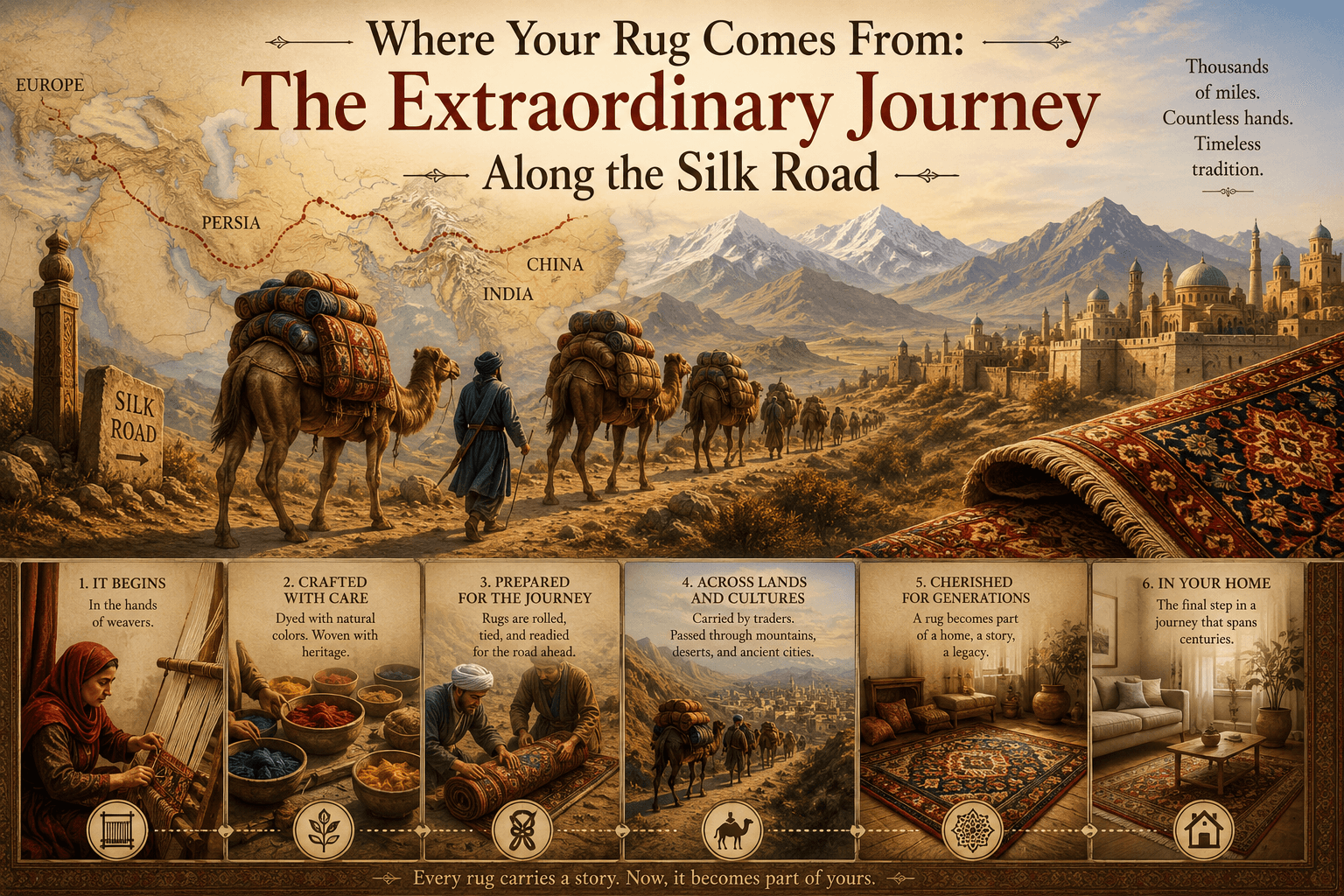
The Silk Road began from Chang'an in China approximately 3,000 years ago, passing through Dunhuang, the Tarim Basin, and the Pamir Plateau — a trade network connecting East Asia, Central Asia, Persia, Turkey, and eventually Rome and Europe. It also linked India, Arabia, and Mongolia. Yilongcarpet
It was the world's first global supply chain. And among everything it carried — silk, spices, gold, glass, ideas, religions — it carried rugs. More specifically, it carried the knowledge of how to make them.
The Silk Road didn't just move goods — it moved minds. Patterns evolved through the journey, absorbing local symbols and styles from culture to culture. Scholars today find shared symbols across carpets from Syria to Xinjiang, reflecting a deep, layered history of migration, trade, and artistic dialogue. Smarthistory
Every rug we clean carries some trace of that dialogue.
China: Where the Fiber Began
In China, caterpillars were bred specifically for the fine silk fiber they produced — more valuable than gold at the time. That silk was woven into rugs for the Imperial Palace and traded along the routes of Asia Minor. Rug Love
Chinese rugs have their own distinct character — soft, elegant, symbolically rich. Dragons, phoenixes, cloud formations, imperial imagery. When a Chinese silk rug comes into our shop, we're handling something made with one of the finest natural fibers on earth, produced by a tradition that predates most of recorded history. Silk requires entirely different care than wool — lower pH cleaning solutions, gentler agitation, careful drying. The fiber is beautiful and unforgiving in equal measure.
Central Asia: The Tribal Heart
As the road moved west out of China through what is now Uzbekistan, Turkmenistan, and Kazakhstan, it entered the territory of the great nomadic tribes — and this is where the hand-knotted pile rug as we know it was truly born.
The Turkestan region of Central Asia is one of the birthplaces of the hand-woven Oriental rug — the cradle of the craft, and also the junction point of the Silk Road. It is from here that the skills of hand-woven rug-making spread across the world. Yilongcarpet
The Turkmen, Uzbeks, Kyrgyz, and Kazakhs wove rugs for their own lives — not for markets, not for merchants, not for export. They developed a broad range of carpet objects, from tent bands and door surrounds to camel trappings and utility bags, fulfilling both decorative and practical functions in the nomadic encampment. Encyclopaedia Iranica
When these rugs eventually reached our cleaning table in Boulder, we know we're dealing with dense, tightly-knotted wool woven on wool foundations — rugs built for survival. They respond beautifully to a proper hand wash. The wool is almost always high-lanolin, which means it cleans up rich and stays soft. These are rugs that were made to last, and with proper care they prove it.
Afghanistan: Crossroads of the Weaving World
No single country sends us more variety than Afghanistan, and that's a direct result of its geography. The Silk Road ran straight through it, carrying tribal traditions from every direction into one extraordinary meeting point.
Many different ethnic groups have been weaving rugs in Afghanistan for generations — Turkmen, Uzbek, Hazara, Baluch — each showcasing unique tribal designs with bold colors and intricate patterns representing the cultural identity of their specific tribe. Nazmiyal Antique Rugs
Afghan rugs are among the most commonly cleaned rugs in our shop, and they require some of the most careful pre-cleaning assessment. As we've written about before, Afghan rugs from the 1980s and 1990s — produced during the disruption of the Soviet war — often have dye stability issues that require testing and specific handling before any water touches them. The tribal tradition is ancient and magnificent. The production conditions of that particular era introduced challenges that a professional cleaner needs to anticipate.
Knowing the history of where a rug comes from is not just academic. It directly informs how we care for it.
Persia: Two and a Half Thousand Years of Mastery
The tradition of carpet weaving in Persia dates back over 2,500 years, making it one of the oldest crafts in the world. The Silk Road, which traversed through Persia, helped spread the art of rug weaving to various parts of Asia. James Barclay
Persian rugs — whether from the court workshops of Tabriz and Isfahan or the tribal looms of the Qashqai and Bakhtiari — are among the most complex and varied textiles we clean. The range is extraordinary: silk Qom rugs with 800 knots per square inch that require white-glove handling; robust tribal Gabbehs that can take a thorough wash; fine Tabriz city rugs with cotton foundations that need to dry completely flat to avoid distortion.
Persian rugs are not one thing. They are a thousand things, produced across a vast country over thousands of years by weavers working in completely different traditions. That's why we inspect every Persian rug individually before we ever start cleaning it.
The Caucasus: Bold, Ancient, Unmistakable
From Persia, the Silk Road arced northwest into the Caucasus — the mountain corridor between the Black and Caspian seas, home to the Kazak, Shirvan, and Karabagh traditions. These are the rugs that stop people in their tracks: bold primary colors, powerful geometric patterns, a raw energy that no court rug has ever quite matched.
Caucasian tribal rugs are typically wool on wool, hand-spun, vegetable-dyed in the finest examples, and woven with a looser knot than Persian city rugs. They clean beautifully and age even better. The wool is thick and lanolin-rich. The colors, when properly cared for, deepen and warm over time rather than fading.
If you have a Kazak, a Shirvan, or a Karabagh — bring it in. We love working on these.
Turkey: Where the Road Ended and the World Market Began
Turkey was the western terminus of the Silk Road — the place where 4,000 miles of trade routes met the Mediterranean and the European market. Patterns evolved through this entire journey, absorbing local symbols and styles — from the dragons of China to the boteh motifs of Persia to the medallions of Anatolia. Smarthistory
Turkish rugs — Oushaks, Heriz-influenced village pieces, Anatolian kilims — carry all of that synthesis. They tend toward warmer palettes and more relaxed geometric forms than Caucasian pieces, and they often have cotton foundations that require attention during washing and drying.
Turkish kilims in particular are flatwoven — no pile — which means no vacuuming, careful handling, and the same shake-and-air approach we recommend for any flatweave. Many of the most beloved rugs in Boulder homes are Turkish kilims, and we clean more of them every year.
One Road. One Shop. All of It Here.
China. Central Asia. Afghanistan. Persia. The Caucasus. Turkey. Every rug-making country on the Silk Road is represented in Boulder homes — and in our cleaning shop — every single week.
Each one arrived here carrying a different fiber, a different dye tradition, a different weaving technique, and a different set of care requirements. That's why rug cleaning is not carpet cleaning. A truck-mounted steam cleaner cannot tell the difference between a machine-made synthetic and a 19th-century Shirvan. We can.
Whatever road your rug traveled to get to Boulder — we know where it came from. Bring it in.
Expert Rug Cleaning — Boulder's home for professional rug care, deep knowledge, and 20+ years of respecting where these things come from.