>
>
Story of a Rug: Cleaning a Tibetan Dragon Rug — What It Takes to Care for One of the Most Extraordinary Objects in Rug Weaving
Story of a Rug: Cleaning a Tibetan Dragon Rug — What It Takes to Care for One of the Most Extraordinary Objects in Rug Weaving
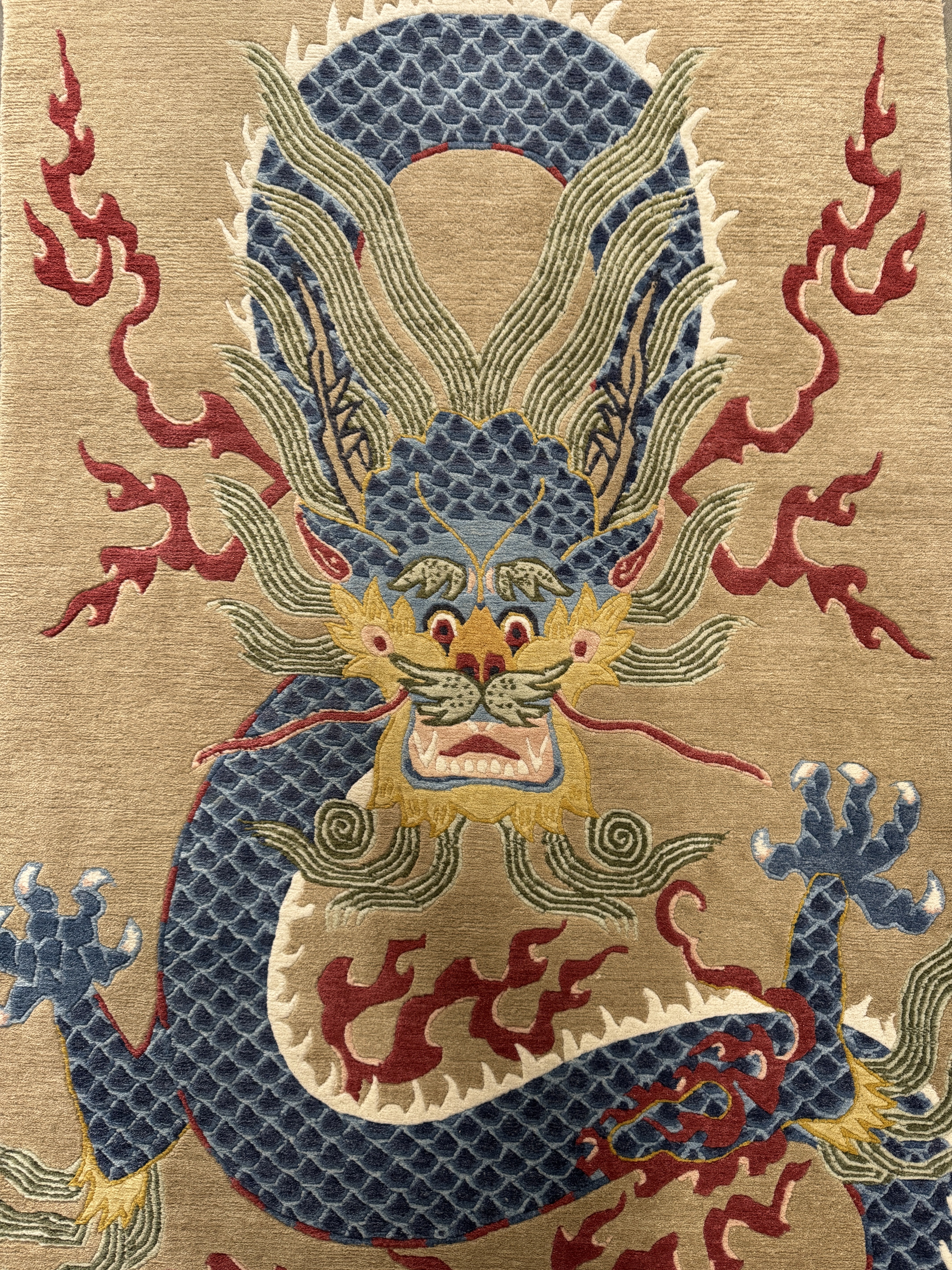
When a Tibetan dragon rug comes through our door at Expert Rug Cleaning, we stop what we are doing and take a good long look. This one — a magnificent hand-knotted piece with a massive celestial dragon coiling across a warm gold field, surrounded by crimson fire clouds — is the kind of rug that reminds you exactly why this craft tradition matters. Here is what it is, what cleaning a piece like this requires, and why proper professional care is non-negotiable for a rug this significant.
What this rug is
This is a hand-knotted Tibetan dragon rug — most likely woven in Nepal between 1970 and 1995 by Tibetan artisan weavers working in the tradition that followed the 1959 diaspora. The pile is deep, sculptural, and extraordinarily lustrous — characteristic of the finest Tibetan weaving — with a warm sandy gold ground field and a massive blue-grey dragon dominating the central composition, surrounded by crimson flame clouds and detailed with gold and olive green accents of remarkable precision.
The dragon depicted here is the Tibeto-Chinese celestial Lung dragon — the supreme symbol of protection, wisdom, and cosmic power in the Tibetan and Chinese artistic tradition. Its presence on a rug marks the piece as something beyond decoration. This is an object with genuine cultural weight, genuine artistic achievement, and genuine value — financial, historical, and personal.
Cleaning it required exactly the kind of care and knowledge that a piece like this deserves.
Why dragon rugs require specialist cleaning
The technical characteristics of a Tibetan dragon rug make it a genuinely specialized cleaning challenge — and understanding why helps explain exactly what we do differently at Expert Rug Cleaning.
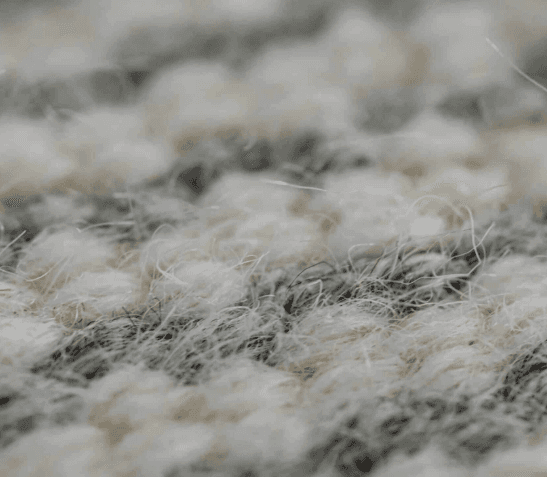
The pile depth is the first consideration. Tibetan rugs are woven with the senneh loop knot technique that produces a characteristically thick, sculptural pile — significantly deeper than the pile of most Persian or Turkish rugs. On a dragon rug of this quality the pile has been deliberately modeled and carved to create dimensional relief effects — the dragon's body rises above the field, the whiskers have depth, the fire clouds float above the ground surface.
This deep, sculptural pile accumulates soil differently than a flatter pile rug. Particulate matter settles deep into the pile structure and compacts at the base — far below what surface cleaning or vacuuming can reach. A compressed air dusting before any wet cleaning is essential for a rug with pile this deep — without it you are washing the top of the pile while leaving accumulated soil compacted at the base.
The multi-color complexity of the design creates dye stability considerations that require careful assessment before any water contacts the rug. The deep blue-grey of the dragon body, the saturated crimson of the fire clouds, the warm gold of the accents and the ground field — these are multiple distinct dye chemistries in close proximity. Dye migration between any of these elements would damage the rug permanently and irreversibly. We test every color zone before washing and adjust our cleaning approach accordingly.
The wool itself — highland Tibetan wool with its characteristic lustre — requires pH-balanced, fiber-safe cleaning chemistry that preserves the natural lanolin that gives the pile its sheen. Harsh cleaning solutions strip this lanolin permanently, leaving the pile dull and dry — and on a rug where the lustrous quality of the wool is central to its visual impact, this kind of damage is significant and immediately visible.
What we do with a rug like this
Every rug that comes to Expert Rug Cleaning for professional cleaning goes through the same careful process — and for a piece this significant we apply every step with particular attention.
We start with a full assessment. Pile condition, foundation integrity, dye stability across every color zone, any signs of moth activity, existing wear, or previous repairs. We look at the back of the rug as carefully as the front. We tell the owner honestly what we find and what the rug needs.
We dust before we wash. Compressed air blasting removes dry particulate matter from the deep pile before any water enters the picture. On a Tibetan rug with pile this deep the volume of soil removed in this step alone is significant — and it is soil that no amount of wet washing would have reached without this preparation.
We wash with pet-safe, non-toxic, pH-balanced solutions formulated for natural fiber rugs. Every product that touches this rug is safe for the wool, safe for the dyes, and safe for every person and animal in the household it goes home to.
We extract without mechanical stress. For a rug with a deep sculptural pile and a foundation carrying the history of decades of use, centrifuge extraction is a risk we do not take. Professional suction extraction removes water thoroughly and effectively without putting rotational stress on the pile structure or the foundation threads.
We dry in a controlled facility environment — elevated, with professional air circulation, monitored until completely and evenly dry from the surface of the pile all the way through to the foundation. No moisture left behind. No risk of mildew or dry rot developing in a pile this deep.
We inspect before it goes home. A final check of pile condition, dye stability, and overall presentation — because a rug this significant deserves to leave our shop looking exactly as good as it should.
Why this rug matters
The celestial dragon on this rug has been watching over spaces and the people in them for decades. In the Tibetan tradition that produced this piece, the dragon is not just a design choice — it is a presence. A protector. A being of wisdom and cosmic power whose image on a rug marks the space it occupies as one worth caring for.
We feel the same way about the rug itself. Objects like this deserve to be cared for properly — cleaned with knowledge, handled with respect, and sent home in the condition that honors what they are.
If you have a Tibetan dragon rug, a Chinese dragon carpet, or any significant handmade piece that needs professional cleaning in Boulder County, bring it to us. We know what we are looking at and we know what we are doing.