>
>
Persian Gabbeh Rugs: What Makes Them So Thick — And Why That Thickness Requires Special Cleaning Care
Persian Gabbeh Rugs: What Makes Them So Thick — And Why That Thickness Requires Special Cleaning Care
Persian Gabbeh rugs are among the thickest, most tactilely satisfying handmade rugs in the world — and their extraordinary pile depth is not an accident. It is the product of centuries of survival engineering in the high-altitude mountains of Iran. Here is the full story of what a Gabbeh rug is, why it is built the way it is, and why that extraordinary thickness requires a cleaning approach that most methods simply cannot deliver.
What a Gabbeh rug is
The word Gabbeh comes from the Persian meaning raw or natural — a reference to the long, uncut pile that defines these rugs visually and physically. Gabbeh rugs were made by nomadic and semi-nomadic tribal weavers — primarily the Qashqai, Luri, and Bakhtiari peoples — in the Zagros Mountain range of southwestern Iran. They were not workshop products made for export. They were domestic objects made for survival — thick, warm, and built to last in one of the harshest environments in the rug-weaving world.
Today Gabbeh rugs are among the most sought-after handmade pieces in the international design market — collected for the same qualities that made them functional in the mountains: extraordinary pile depth, bold saturated color fields, expressive folk art design vocabulary, and a tactile warmth that no other rug tradition quite matches.
Why they are so thick — the Zagros Mountain winters
The pile depth of a Gabbeh rug is not a design choice. It is a response to the physical environment where these rugs were made and used.
The Zagros Mountain range runs through southwestern Iran — a dramatic series of parallel ridges and high plateaus where the Qashqai and Luri tribes have followed seasonal migration routes for centuries. Summer pastures sit at altitudes above 8,000 feet. Winter camps descend to lower valleys but remain cold — with temperatures well below freezing and stone or earthen floors that hold the cold through the night.
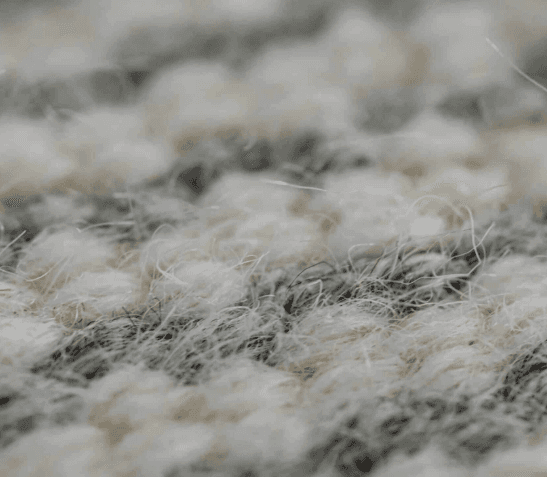
A thick, densely knotted rug with a deep pile of 15 to 25 millimeters provides genuine thermal insulation in this environment. The pile traps air. The dense foundation blocks cold from penetrating from below. For a family sleeping on the ground in a tent or a stone dwelling at altitude, the difference between a thin rug and a thick Gabbeh is a genuinely comfortable night versus a genuinely miserable one.
The highland Zagros sheep that provide the wool for Gabbeh rugs are part of the same survival equation. These animals produce a coarser, denser, lanolin-rich wool specifically adapted to cold mountain conditions — a wool that has more natural insulating properties than the fine wool of lowland Persian breeds and that produces a pile with a warmth and resilience that cannot be replicated with imported or commercial fiber.
The design language — expressive, bold, and entirely its own
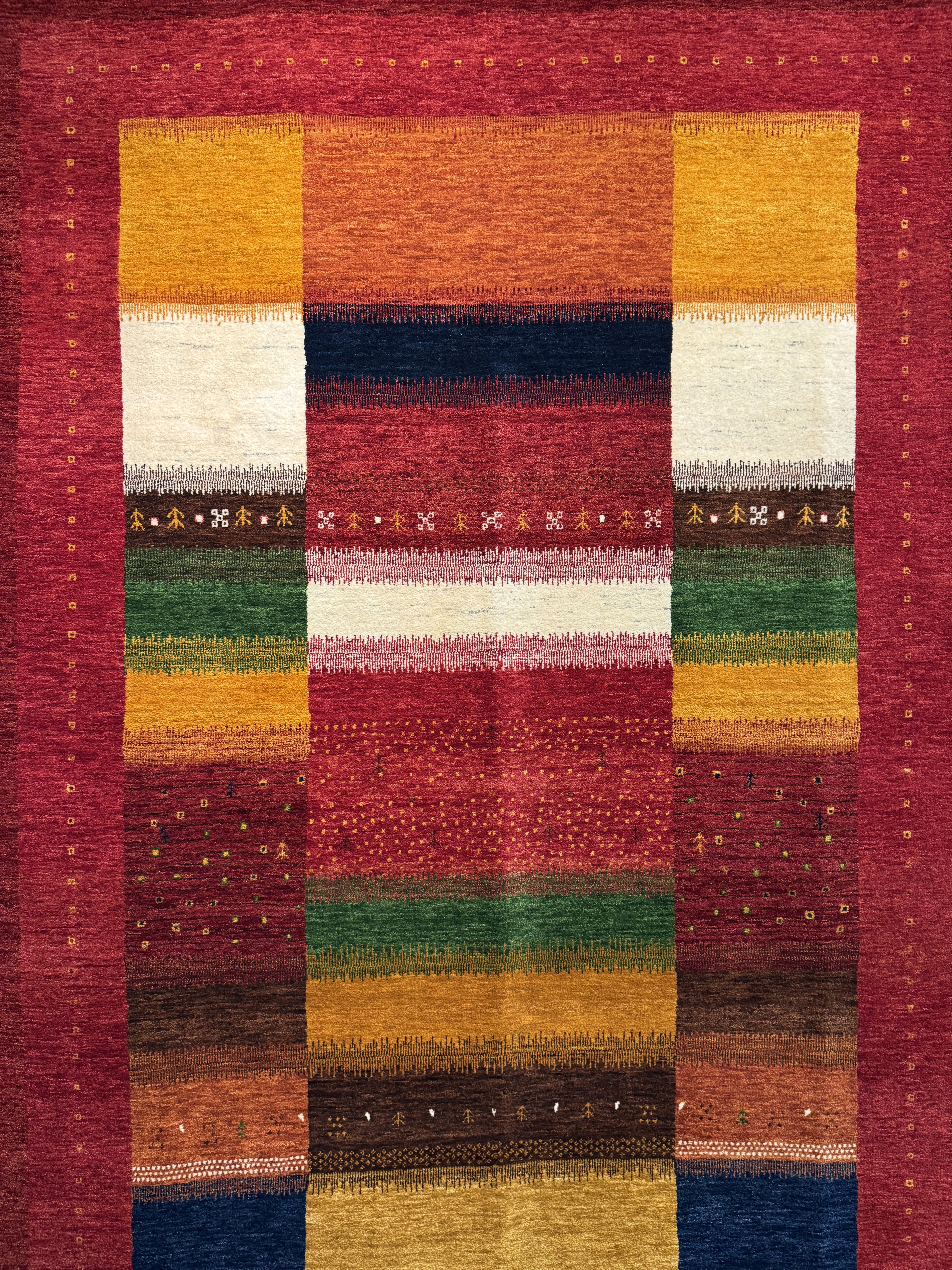
Gabbeh design breaks every rule of formal Persian workshop weaving. Where a Kashan or Tabriz rug is precise, symmetrical, and elaborately detailed, a Gabbeh is intuitive, asymmetrical, and freely expressive.
Gabbeh weavers worked without cartoons or master designs. They wove from memory, from imagination, and from the landscape and daily life immediately around them. Figures — shepherds, horses, deer, birds, human silhouettes — float freely across solid color fields. Trees grow from simple horizon lines. Geometric motifs appear and disappear without formal border structure to contain them.
The color palette is equally bold. Saturated indigo, rich madder red, warm saffron yellow, deep forest green — often as nearly solid fields with minimal internal patterning. This graphic simplicity and color boldness is what caught the attention of the international design world in the late 20th century and what makes Gabbeh rugs work so naturally in contemporary interiors.
Zollanvari — the company that changed everything
The name that defined the modern Gabbeh market internationally is Zollanvari — an Iranian company based in Shiraz that began working directly with Qashqai tribal weavers in the Zagros highlands in the mid-20th century.
Zollanvari's contribution was not just sourcing and exporting tribal Gabbeh rugs — it was applying a design and quality sensibility to the market that elevated tribal weaving into the international design conversation. Working with European architects and designers in the 1980s and 1990s who recognized the modernist potential of the Gabbeh aesthetic, Zollanvari helped transform the perception of these rugs from humble tribal objects into sought-after design pieces.
Zollanvari pieces are distinguished by their wool quality — highland Zagros fiber selected for consistency and pile character — and by their color depth, achieved through natural and high-quality synthetic dyes that produce the luminous saturated fields the brand is known for. A Zollanvari Gabbeh is the benchmark against which all other modern Gabbeh production is measured.
Why Gabbeh rugs require specialist cleaning
The extraordinary pile depth of a Gabbeh rug — the quality that makes it so warm, so tactile, and so visually distinctive — is also what makes it the most challenging rug type to clean properly. And it is why in-home cleaning or standard carpet cleaning methods are genuinely inadequate for a Gabbeh.
Deep pile accumulates soil differently. The 15 to 25 millimeter pile depth of a traditional Gabbeh traps particulate matter at the base of the pile — compacted by foot traffic far below the surface layer that vacuuming addresses. A surface clean or in-home extraction treatment reaches the top of the pile. It does not reach the base where the soil has accumulated over months and years of use.
At Expert Rug Cleaning we start every Gabbeh with compressed air dusting before any water touches the rug. This blasts dry particulate matter out of the deep pile from the back — removing soil that no amount of wet washing would reach without this preparation step. The volume of material that comes out of a Gabbeh during this step is consistently remarkable and consistently left behind by every surface cleaning method.
The highland Zagros wool requires pH-balanced, lanolin-safe cleaning chemistry. The natural lanolin in highland wool is part of what gives Gabbeh pile its warmth, its resilience, and its luster. Harsh cleaning solutions or inappropriate chemistry strips this lanolin permanently — leaving the pile dull, dry, and diminished in exactly the qualities that make a Gabbeh worth owning. Every product we use is pH-balanced, biodegradable, and specifically safe for natural wool fibers.
Deep pile drying requires controlled facility conditions. A Gabbeh with 20 millimeters of pile holds significantly more moisture after washing than a fine Persian rug — and that moisture needs to escape completely and evenly from the full depth of the pile before the rug goes home. A Gabbeh that is not completely dry all the way through is a mildew risk — and in a pile this deep, incomplete drying can be very difficult to detect at the surface. We dry every Gabbeh in a controlled facility environment with professional air circulation equipment until completely and evenly dry throughout.
Extraction without centrifuge stress. Gabbeh rugs — especially older tribal pieces and Zollanvari pieces with thick highland wool foundations — should not go through a centrifuge. The mechanical stress of high-speed rotation on a heavy, deep-pile foundation is a genuine risk. We use professional suction extraction that removes water thoroughly without any rotational stress on the pile or the foundation.
The result
A properly cleaned Gabbeh rug is a revelation. The pile lifts back to its full depth. The colors return to their original saturation. The lanolin in the wool is restored and the pile has the warm, slightly lustrous quality it was always supposed to have. The rug feels lighter, fresher, and more alive — and the thermal insulating quality that was designed into it centuries ago in the Zagros Mountains is fully restored.
If you have a Gabbeh rug — Zollanvari or otherwise — that is overdue for a professional cleaning, bring it to Expert Rug Cleaning in Boulder. We know what these rugs are and we know exactly what they need.