>
>
Mamluk Rugs: History, Origin, and Why They Remain Some of the Most Extraordinary Rugs Ever Woven
Mamluk Rugs: History, Origin, and Why They Remain Some of the Most Extraordinary Rugs Ever Woven
Mamluk rugs are among the rarest and most extraordinary objects ever produced in the history of weaving. Woven in Cairo between 1450 and 1550 CE, these hypnotic geometric masterpieces now live in the world's great museums — but we have a selection in our Boulder store right now. Here's the story behind them.

If you've ever stood in front of a Mamluk rug in a museum and felt like you were looking at something from another world, you're not alone. These rugs stop people in their tracks. The geometry is hypnotic. The colors are unlike anything else in the history of weaving. And the craftsmanship — knot by knot, row by row — represents one of the highest achievements in the entire tradition of rug making.
At Boulder Rug Collective and Expert Rug, we handle a lot of extraordinary rugs. Mamluk rugs occupy a category all their own.
Where Mamluk rugs come from
Mamluk rugs were woven in Cairo, Egypt, primarily between the late 15th and early 16th centuries — roughly 1450 to 1550 CE. They take their name from the Mamluk Sultanate, the dynasty that ruled Egypt and much of the eastern Mediterranean world from 1250 to 1517.
The Mamluks were a military caste, originally enslaved soldiers of Turkic origin who rose to political power and built one of the most sophisticated courts in the medieval Islamic world. Cairo under the Mamluks was one of the great cultural capitals of its era — a city of monumental architecture, refined craftsmanship, and extraordinary artistic output.
Rug weaving was a central part of that output. The workshops of Cairo produced rugs for the Mamluk court, for export to Europe, and for the great mosques and palaces of the city. These were not floor coverings in the utilitarian sense. They were prestige objects — statements of power, wealth, and artistic mastery.
The design language of Mamluk rugs
Nothing in the history of carpet weaving looks quite like a Mamluk rug. The design system is entirely its own.
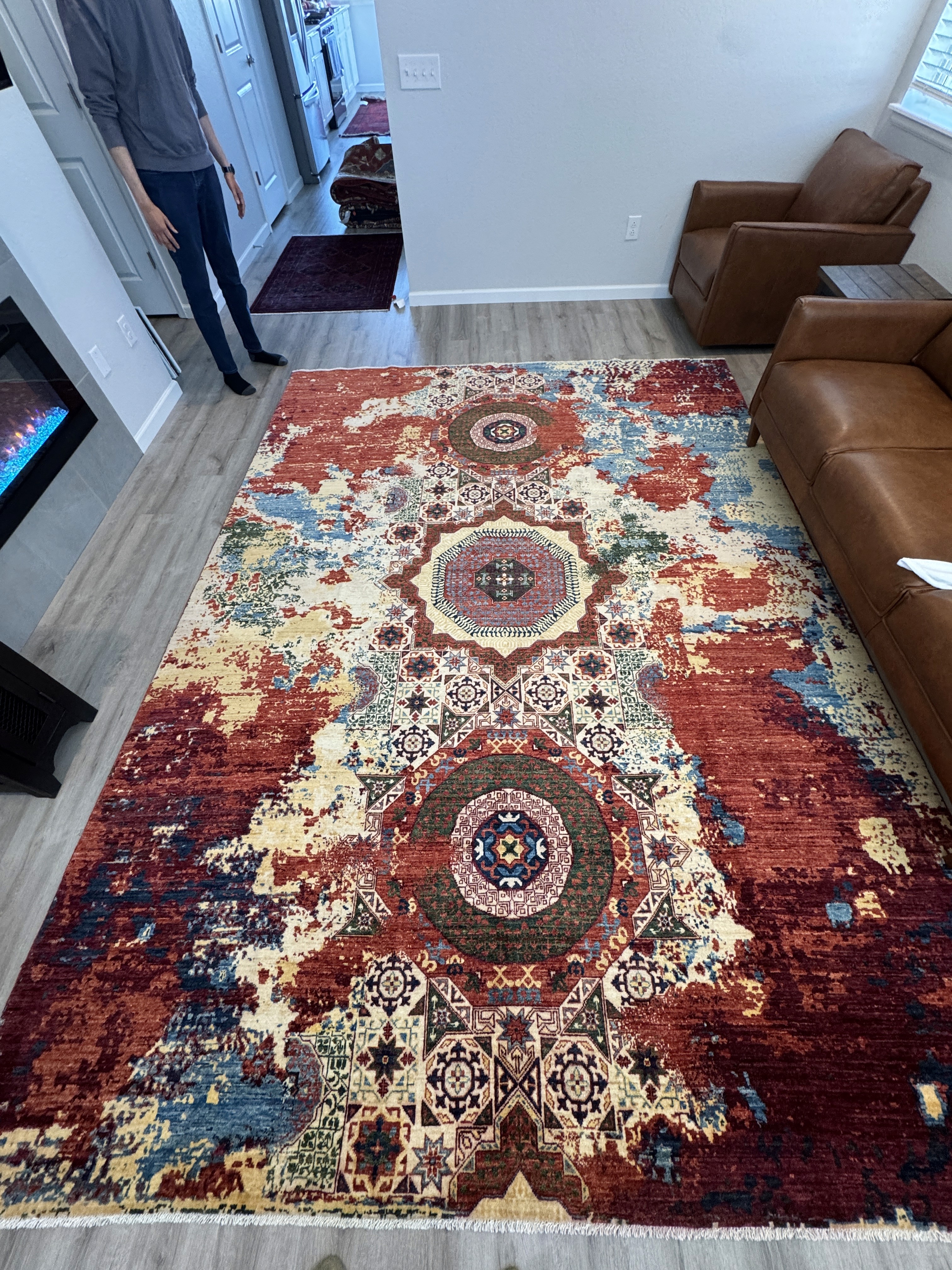
The central field is typically dominated by a large octagonal or star-shaped medallion, surrounded by smaller geometric satellites — pentagons, cartouches, and complex interlocking forms that radiate outward in every direction. The overall effect is kaleidoscopic — a geometry so precise and so intricate that it feels almost mathematical.
The color palette is equally distinctive. Mamluk rugs are woven primarily in three colors — a deep saturated red, a rich forest green, and a clear sky blue. Occasionally ivory and yellow appear as accents. The restraint of the palette is part of what makes the designs so powerful. With only three or four colors, Mamluk weavers created an optical complexity that more colorful rugs rarely achieve.
There are no figures, no animals, no narrative scenes in Mamluk rugs. The entire visual world is geometric and abstract — a reflection of the Islamic artistic tradition's emphasis on pattern, mathematics, and the infinite.
The knot: S-spun wool and a technique found almost nowhere else
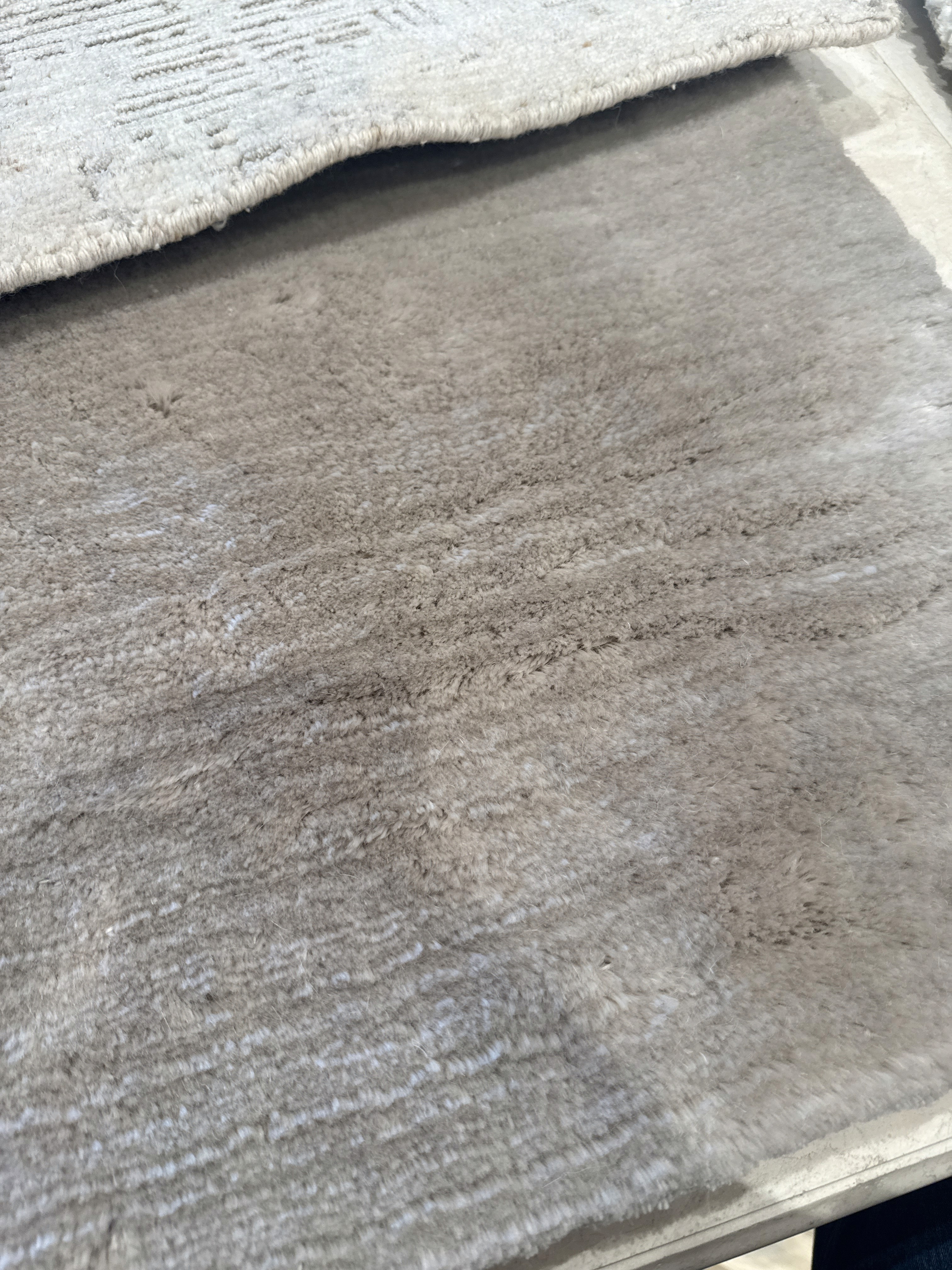
One of the most distinctive technical features of Mamluk rugs is the wool itself. Mamluk pile is woven from S-spun wool — meaning the fibers are spun in a clockwise direction, the opposite of the Z-spun wool used in virtually every other rug-weaving tradition in the world.
This gives Mamluk pile a distinctive silky, lustrous quality unlike anything woven in Persia, Anatolia, or Central Asia. The wool catches light differently. It has a sheen and a depth that is immediately recognizable to anyone who has handled a genuine example.
Mamluk rugs are woven using the symmetrical Turkish knot — also called the Ghiordes knot — tied on a wool foundation of warp and weft. Knot counts vary, but fine examples typically achieve between 80 and 130 knots per square inch. The finest known examples reach significantly higher, with some museum pieces recording over 200 knots per square inch — a density that requires extraordinary skill and patience to achieve at any scale, let alone across a rug that might measure 8 by 12 feet or larger.
Mamluk rugs in the world's great museums
Because Mamluk rugs were produced in relatively small numbers over a relatively short period, authentic examples are extremely rare. The great majority of surviving pieces are now held in museum collections around the world.
The Vienna Kunsthistorisches Museum holds one of the finest collections of Mamluk rugs in existence, including several large-format examples that give a full sense of the scale and ambition of these weavings. The Museum of Islamic Art in Cairo holds important examples as well, including pieces with documented provenance connecting them directly to Mamluk court workshops.
The Metropolitan Museum of Art in New York, the Museo Nazionale del Bargello in Florence, and the Thyssen-Bornemisza collection in Madrid all hold significant Mamluk pieces. The Bargello examples are particularly notable because they appear in Renaissance-era paintings by Florentine masters — evidence that Mamluk rugs were being exported to Europe and were prized by the wealthiest Italian families of the 15th and 16th centuries.
Seeing a Mamluk rug in person, even behind glass, is a genuinely different experience from seeing one in a photograph. The wool has a presence and a luminosity that reproduction cannot capture.
The transition: from Mamluk to Ottoman
In 1517, the Ottoman Sultan Selim I conquered Egypt, ending the Mamluk Sultanate. The Cairo workshops did not disappear — they continued weaving under Ottoman patronage — but the design language shifted dramatically over the following decades.
The tight geometric abstraction of the Mamluk tradition gradually gave way to the curvilinear floral vocabulary of Ottoman court taste. Scrolling arabesques, cloud bands, and naturalistic flowers replaced the stark polygonal geometry of the earlier work. By the mid-16th century, the rugs coming out of Cairo looked fundamentally different from their Mamluk predecessors.
These transitional pieces — sometimes called Mamluk-Ottoman or simply Cairo rugs — are fascinating objects in their own right, carrying traces of both traditions. But they mark the end of the Mamluk style as a living tradition. True Mamluk rugs were woven within a window of roughly 75 to 100 years, which is part of what makes them so rare and so extraordinary.
What makes Mamluk rugs relevant today
For collectors and serious rug lovers, Mamluk rugs represent the outer edge of what the craft has ever achieved. They are proof that rug weaving is not a minor decorative art — it is a major art form, capable of the same ambition, complexity, and beauty as any painting or sculpture.
For anyone who lives with handmade rugs — whether a centuries-old tribal piece or a modern hand-knotted rug from Afghanistan — the Mamluk tradition is a reminder of what these objects really are. Not floor coverings. Not home accessories. Objects made by human hands, carrying history, culture, and craft in every knot.
That's something worth taking care of.
At Boulder Rug Collective, we carry a curated selection of handmade rugs with deep roots in the same weaving traditions that produced the great Mamluk pieces. And when your rug needs cleaning — whether it's a family heirloom or a recent find — we treat it with the same respect every handmade piece deserves.