How to Ship a Rug Safely: A Complete Guide for Boulder Homeowners
Shipping a rug sounds straightforward — roll it up, stick it in a box, send it off. But done wrong, you can end up with permanent creases, mildew, dye bleeding, damaged fringes, and a rug that arrives in worse condition than it left. Here is everything you need to know to ship your rug safely — whether you are sending it out for cleaning, moving, selling, or returning a purchase.

How to Ship a Rug Safely: A Complete Guide for Boulder Homeowners
Expert Rug Cleaning | Boulder, CO | 7 min read
Excerpt: Shipping a rug sounds straightforward — roll it up, stick it in a box, send it off. But done wrong, you can end up with permanent creases, mildew, dye bleeding, damaged fringes, and a rug that arrives in worse condition than it left. Here is everything you need to know to ship your rug safely — whether you are sending it out for cleaning, moving, selling, or returning a purchase.
Why shipping a rug requires more care than most people expect
A handmade rug is not a piece of furniture you can bubble wrap and hope for the best. The fibers, the foundation, the dyes, and the fringes are all vulnerable to specific types of damage that happen during transit — and most of them are completely preventable with the right preparation.
The most common shipping mistakes we see at Expert Rug Cleaning are wrapping rugs in plastic, folding instead of rolling, and failing to protect the fringes. Each of these mistakes causes a different type of damage — and some of it is permanent.
Here is how to do it right.
Step 1 — Vacuum first
Before you do anything else, vacuum the rug thoroughly on both sides. Loose dirt and grit that gets trapped inside a rolled rug during transit acts as an abrasive against the fibers — grinding into the pile with every bump and shift the package takes on its journey.
A clean rug is also safer to handle for whoever receives it. If you are shipping your rug to us for professional cleaning, a quick vacuum first is appreciated but not required — we will handle the deep cleaning when it arrives.
Step 2 — Roll it — never fold it
This is the most important rule and the one most commonly broken.
Always roll your rug. Never fold it.
Folding creates sharp creases in the foundation that can crack the warp and weft threads — especially in older rugs, antique pieces, or any rug with a stiff or brittle foundation. These creases can be permanent and in some cases cause structural damage that is difficult or impossible to fully repair.
Roll the rug with the pile facing inward — that is, face to face, pile on the inside. This protects the pile surface during transit and reduces the risk of pile crushing or surface abrasion.
Roll as tightly as you reasonably can without forcing it. A tight, even roll holds its shape better during transit and is easier to pack securely.
Step 3 — Wrap in something breathable
Once the rug is rolled, wrap it in a breathable material before anything else touches it. The best options are kraft paper, rug wrap, or a clean cotton sheet or fabric cover.
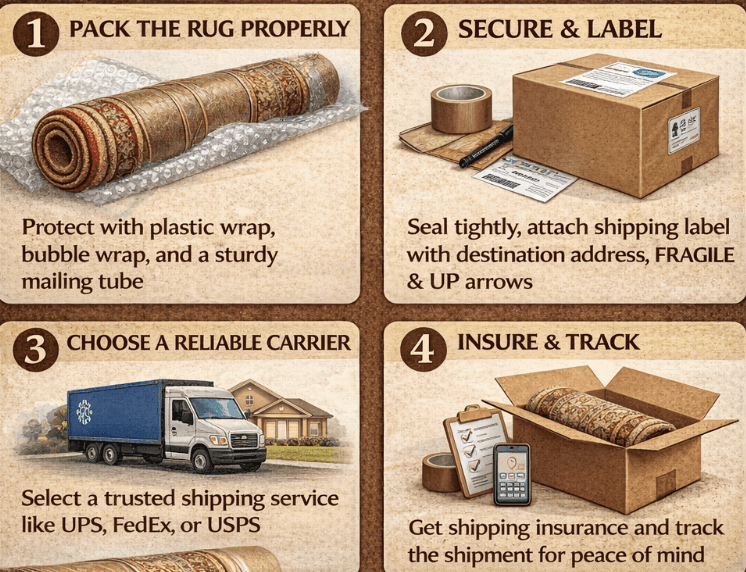
Do not wrap the rug directly in plastic. This is the single most common shipping mistake and it causes real damage. Plastic traps moisture against the fibers — and moisture trapped against wool, silk, or cotton fibers for days during transit creates the conditions for mildew, dye bleeding, and fiber degradation. Even a rug that feels completely dry can release enough moisture in a warm, sealed plastic environment to cause problems.
Breathable wrapping allows any residual moisture to escape while still protecting the rug from dirt and handling damage.
Step 4 — Protect the fringes
Fringes are the most vulnerable part of a rug during shipping. They are the structural warp threads of the foundation — not decorative trim — and they can be easily pulled, tangled, frayed, or torn if they are not protected.
Fold the fringes back against the end of the rolled rug before wrapping. Make sure no tape touches the fringes directly — tape adhesive will pull fibers and cause damage that is difficult to repair. If you are using tape to secure the wrapping, keep it well away from the fringe line.
Step 5 — Use a carpet tube if possible
For larger rugs especially, a carpet shipping tube is the best outer container available. Carpet tubes are available from moving supply stores and some shipping carriers. Slide the wrapped, rolled rug into the tube and cap both ends securely.
A tube protects the roll from being compressed, bent, or crushed in transit — which is a real risk when packages are stacked and handled by automated sorting systems. It also makes the package much easier to handle at both ends.
For smaller rugs where a tube is not practical, a heavy-duty cardboard box sized as close to the rolled rug as possible is the next best option. Avoid oversized boxes where the rug can shift around during transit.
Step 6 — Add a waterproof outer layer last
Once the rug is wrapped in breathable material and inside its tube or box, you can add a waterproof outer layer for weather protection. A plastic bag or plastic wrap on the outside of the cardboard is fine — the key is that the plastic never touches the rug directly. Breathable layer first, waterproof protection second.
Choosing a carrier and insuring your rug
Most rugs ship safely via UPS or FedEx with standard ground or freight service depending on size. For smaller rugs USPS Priority Mail is a reasonable option.
If your rug has significant value — whether monetary or sentimental — do not skip the insurance. Declare the full replacement value and require a signature on delivery. The additional cost is minimal compared to the cost of a claim on an uninsured piece.
For very large or very valuable rugs, a specialist art and antique shipper is worth considering. These carriers have experience handling fragile and high-value textiles and typically offer better handling protocols than standard parcel services.
What to do if you are shipping to us for cleaning
If you are shipping your rug to Expert Rug Cleaning for professional hand-wash cleaning, give us a call before you ship and we will walk you through the process, confirm the address, and let you know what to expect when your rug arrives.
We handle rugs shipped to us from throughout Colorado and beyond — and we ship cleaned rugs back safely using the same careful packing standards we have outlined here. Every rug that leaves our shop is rolled properly, wrapped in breathable material, and packed to arrive in the same condition it left.
If you are local to Boulder and the Front Range, drop-off is always the easiest option. No shipping required — and you get to meet the team that will be caring for your rug.