>
>
Story of a Rug: A Century-Old Persian Mahal Gets a Deep Clean at Expert Rug Cleaning in Boulder
Story of a Rug: A Century-Old Persian Mahal Gets a Deep Clean at Expert Rug Cleaning in Boulder
This massive antique Persian rug came to us at Expert Rug Cleaning carrying what looked like decades of Colorado life in its pile. Deep navy field, rich crimson border, an all-over floral design so dense and so finely knotted it takes your breath away up close. It was old, it was heavily soiled, and it needed a serious professional cleaning. Here is exactly what we did — and how it came out on the other side looking extraordinary.
What this rug is
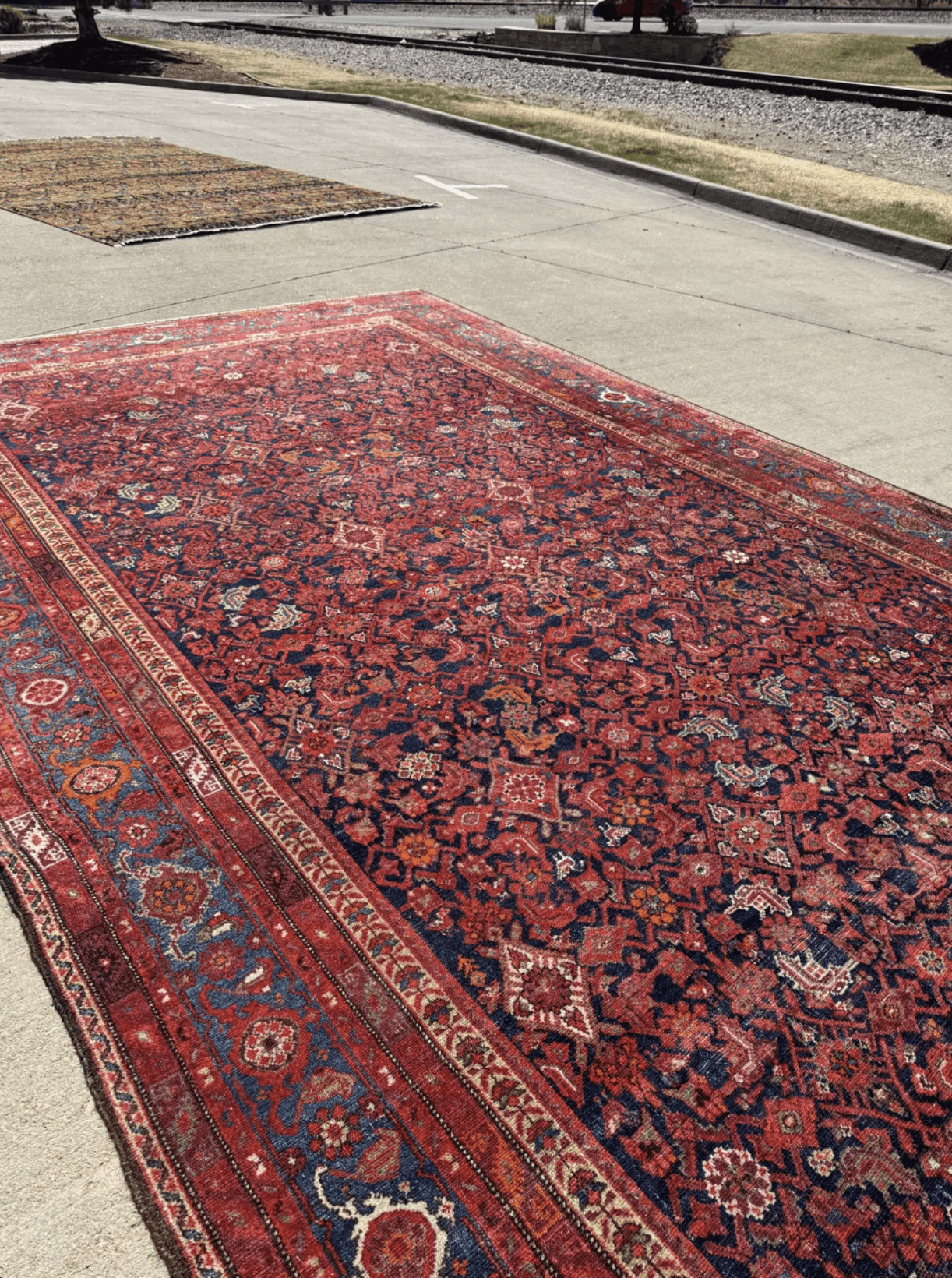
This is a large format antique Persian Mahal rug — most likely woven in the Arak region of west-central Iran between the late 19th and early 20th century, placing it at somewhere between 100 and 130 years old. Mahal rugs were produced in and around the city of Arak — historically known as Sultanabad — in some of the most productive rug-weaving workshops in all of Iran.
Mahal rugs occupy a fascinating place in the Persian rug hierarchy. They were not the ultra-fine court pieces of Kashan or Tabriz — they were made for export, for use, for real life. They were woven to be walked on, lived with, and passed down. The knot counts are lower than the finest Persian pieces but the wool quality is exceptional — thick, lustrous, and extraordinarily durable — and the designs are bold, confident, and deeply satisfying in a way that more formal court pieces sometimes are not.
This particular rug features a classic Mahal all-over Herati pattern — the famous fish-and-flower design that fills the deep navy field from edge to edge with an almost hypnotic density. The Herati pattern is one of the most recognized and most replicated designs in the history of Persian weaving, and on a genuine antique piece like this one, executed in hand-spun wool with natural dyes that have mellowed and deepened over a century of use, it achieves something that no reproduction has ever quite matched.
The border is a multi-stripe composition in deep crimson and teal with classic Persian floral cartouches — bold, generous, and perfectly proportioned to the scale of the rug.
The size
This is a large rug — approximately 10 by 16 feet — which puts it squarely in the gallery or great room category. A rug this size, this age, and with this design density is a significant object. It is not a floor covering. It is the focal point of whatever room it lives in.
What it looked like when it arrived
When this rug arrived at Expert Rug Cleaning it was carrying the kind of deep, accumulated soil that only comes from decades — possibly generations — of use in a home. The surface colors were muted and flat. The pile had a heaviness to it that told us immediately there was a serious amount of embedded particulate matter deep in the foundation. The rug felt dense and stiff in a way that had nothing to do with its age and everything to do with what was living inside it.
A rug this old and this valuable needed a careful, methodical approach. We were not going to rush it.
What we were worried about
With any antique Persian rug, dye bleeding is the primary concern going into a wet wash. The natural dyes used in rugs of this era — madder root for the reds, indigo for the navy, pomegranate and oak gall for the yellows and browns — are generally stable after a century of oxidation. But some early synthetic dyes that were introduced into Persian weaving regions in the late 19th and early 20th century can be unpredictable when wet.
On a rug with this much red and this much navy in close proximity, dye migration — red bleeding into the ivory border elements, navy running into the field — was a real possibility we had to plan for and watch carefully throughout the entire process.
As it turned out, this rug handled everything beautifully. Barely a whisper of dye movement throughout the entire wash. A rug that has been wet before — and a piece this old almost certainly has been — tends to behave. The dyes have already done whatever moving they are going to do over the course of a century. This rug, as we said to each other more than once during the process, was not on its first ride.
Step one — compressed air dusting
Before any water touched this rug, we ran it through a thorough compressed air dusting process. This is a critical first step that most people do not think about — and that most cleaning methods skip entirely.
A rug this age and this size had accumulated an extraordinary amount of dry particulate matter deep in its pile. Dust, fine grit, dried organic material, and decades of airborne particles that had settled into the foundation over generations of use. If you wash a heavily soiled rug without removing the dry particulate matter first, you are washing mud — turning dry grit into a wet slurry that is significantly harder to remove from the fibers than dry dust.
Compressed air blasting drives the dry soil out of the pile from the back, loosening and removing the particulate matter before water ever enters the picture. The amount of material that came out of this rug during the dusting phase told us everything we needed to know about how long it had been since its last proper cleaning.
Step two — washing with pet friendly, non-toxic cleaning products
Once the rug was thoroughly dusted we moved to the wash. We used our full wet wash process — gentle, pH-balanced, completely non-toxic and pet-safe cleaning solutions that are specifically formulated for natural fiber rugs.
No harsh solvents. No bleach. No optical brighteners. No synthetic fragrances. Every product that touched this rug is safe for the wool fibers, safe for the natural dyes, safe for the people who will live with it, and safe for the pets who will sleep on it.
You can see in the wash photos exactly what came out of this rug. The water running off the surface during washing was carrying decades of embedded soil — the kind of deep, dark particulate matter that had been compressing the pile and muting the colors for years. As the rug was worked and rinsed, the colors began to emerge again. The navy deepened. The red border came alive. The ivory accents in the Herati field re-emerged with a clarity they had not had for a very long time.
Step three — extraction without the centrifuge
This is where our process made a specific and important choice for this rug.
Many professional rug cleaning operations use a centrifuge — a high-speed spinning drum that extracts water from the rug rapidly after washing. For some rugs, in some conditions, this is an acceptable approach. For a rug this old, this large, and with a foundation that has seen a century of use, a centrifuge is a real risk. The mechanical stress of high-speed rotation on an aged wool foundation — warp threads that have been under tension for over a hundred years — can cause distortion, foundation damage, and in the worst cases structural failure along seams or in areas where the foundation has any existing weakness.
We used a powerful suction extraction system instead — a professional wet vacuum system that pulls water out of the pile and foundation thoroughly and effectively without putting any mechanical stress on the rug. It takes longer. It requires more passes. But for a rug like this one, it is the only approach that makes sense.
The rug came out of extraction damp but not saturated — ready for controlled air drying without any of the risks that a centrifuge would have introduced.
The result
Look at that rug in the final photo. Then look at what was running off it during the wash.
The navy field has the depth and richness it was woven with. The crimson border glows. The Herati pattern across the field has a clarity and presence that was completely invisible under the layer of accumulated soil. This is what a century-old Persian Mahal is supposed to look like — and it looks extraordinary.
No dye bleeding. No distortion. No foundation damage. A rug that came in heavy, muted, and exhausted and left clean, vibrant, and ready for another generation of life on a Colorado floor.
This is why we do what we do.
If you have an antique or heavily soiled rug that needs professional care in Boulder County — whether it is a Persian piece, a tribal rug, or any handmade rug that deserves better than a surface clean — bring it to us. We will treat it with the same care and the same honest approach we gave this one.